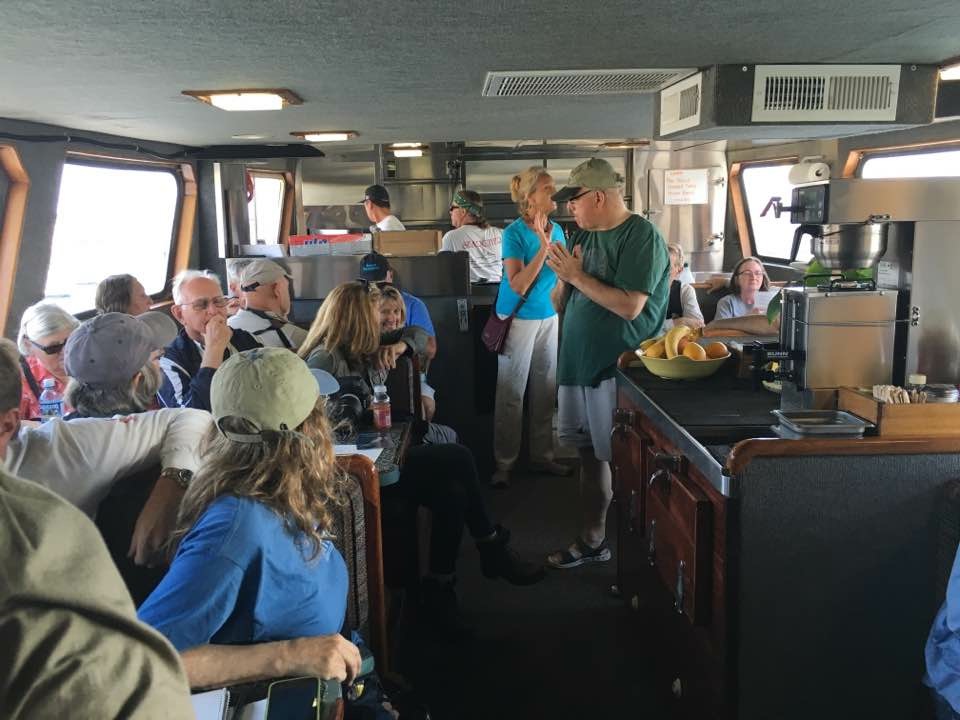
2016 Labor Day Pelagic Birding Tour is off and running!
Our annual 5-day birding adventure through the southern-most ABA waters and through the Channel Islands departed today with 25 birders and 4 leaders.
The northern elephant seal (Mirounga angustirostris) is one of four species of pinnipeds regularly found in the waters around Baja California (for a discussion of pinnipeds in general, please see my Rob-servations Blog #10). There are two species of elephant seal in the world, the northern and southern, with the southern one being found in the southern hemisphere. The northern elephant seal is mostly found in the eastern North Pacific Ocean and is the species we see in Baja.
Elephant seals are members of the pinniped family Phocidae, as is the harbor seal, another Baja pinniped species.
All members of this family share various traits that help distinguish them from the other major group of pinnipeds, the family Otariidae (which includes the California sea lion and Guadalupe fur seal, both species found in Baja).
Elephant seals (and other phocids) lack an external ear flap, have relatively small front flippers (compared to otariids), cannot rotate their hind flippers forward, hunch along awkwardly when on land, and primarily use their hind flippers and bodies when swimming underwater (see Blog #10 for more details).
As a general rule, phocids tend to have little to no sexual dimorphism, while otariids are characterized by having sexual dimorphism. The term “sexual dimorphism” refers to the differences between male and female members of a species. Many people equate the term with differences in body size, but the term also encompasses other differences, such as the bright colors in some male birds, or the antlers in male deer. The BIG exception to the lack of sexual dimorphism in phocids is … the elephant seal! Male elephant seals are gigantic, much larger than the females. Elephant seals are not only the largest pinnipeds, but are also the most sexually dimorphic mammals. Adult male northern elephant seals get up to 4.2 meters (14 feet) and 2,500 kilograms (5,500 pounds), compared with 2.8 m (9 feet) and 600 kg (1,300 pounds) for females. Southern elephant seals get even larger!
Oftentimes a size disparity between male and female mammals suggests a polygynous mating system, in which a few males mate with many females. Elephant seals have such a mating system, where large bulls compete with each other for control of desirable sections of beach.
The best beaches have good haul-out sites for females to come ashore, give birth to their pups, nurse them for one month, and then mate again before heading back out to sea. The beachmaster bulls have mating access to many females (and get to pass on their genes to many pups), whereas the vanquished males may not get to mate at all that season.
Northern elephant seals haul out twice a year in certain select locations along the California and Baja California coasts. During our Searcher Natural History Tour to Baja, we spend a day on West San Benito Island, one of the three San Benito Islands that serve as the primary haul-out site for elephant seals in Baja. In addition to hauling out for pupping and mating, elephant seals haul out later in the year for molting, a process by which they shed old hair and skin quite rapidly (all mammals continuously shed old hair and skin, but elephant seals go through a “catastrophic molt”).
We always see elephant seals on West San Benito Island. However, the composition of the elephant seal groups varies by month. During the Searcher’s first trips of the year (late January and early February), we can see adult males and females, as well as very young pups. As the season progresses, we see fewer adult males and the pups are getting larger. By the time we get to April, few adult males are left, many of the pups have been weaned and their mothers have departed, and other elephant seals (mostly sub-adults) have arrived for molting.

Rob Nawojchik, author of Rob-servations, guides Searcher passengers around the elephant seal haul-out areas on scenic Isla San Benito.
When elephant seals leave the San Benito Islands, they head to their feeding grounds thousands of miles away in certain areas of the North Pacific Ocean. While there, they dive very deep to feed on squid. Elephant seals are the champion divers among pinnipeds, capable of diving deeper and longer than other species. In fact, the diving capabilities of elephant seals are comparable to that of sperm whales. Much of what we know about the movements and diving patterns of elephant seals comes from the use of satellite-linked time-depth recorders (TDRs) that are attached to the seals at their haul-out sites. Due to their double migration (one for reproduction and one for molting), northern elephant seals end up migrating more than any other mammal, up to 21,000 km (13,000 miles) per year!
While observing these amazing animals during our Baja tours, I like to remind everyone that elephant seals were hunted to the brink of extinction. It is only because of their current protected status, and safe havens such as the San Benito Islands, that the northern elephant seal has made such a remarkable recovery.
We were touched to see a Facebook post by Linda Riseborough about enjoying her tea from a Searcher souvenir mug. She posted “We drink our tea from Searcher mugs on the Norfolk Broads in the UK. I wonder how far other mugs travel?!”
So we invited others to weigh in! Mugs have been spotted in Ewa Beach, Oahu, Hawaii; Ouderkerk aan de Amstel (Amsterdam area) the Netherlands; and York England! Please send in a photo of your Searcher mug and we’ll post it along with the others.
We’d love to see the far and distant lands that our Searcher Natural History Tours mugs have travelled!
Rene Kadijk has been using his old-school mug since 1995! This mug resides near Amsterdam in The Netherlands.
Linda’s mug is enjoying the scenery on the Norfolk Broads in the UK.
Louise Ling enjoys her cuppa in York, England which “brings back so many brilliant memories” of her trip aboard Searcher to Baja California.
And we shouldn’t forget about the Searcher Natural History Tour water bottle! Karen Madsen and Julie Brownell Walters didn’t forget it on a recent whalewatch trip.
Get offshore with us!
2017 dates are set and it’s time to book your spot on the annual 5-day birding tour covering the southernmost ABA area. We never know exactly what we’ll find, but it’s always an exciting search!
Target birding areas include deep-water canyons, underwater seamounts, and around islands of the southern California bight. From San Diego, you’ll travel north over the 9 Mile Bank, through the Channel Islands, and past Point Conception to Arguello Canyon, Rodriguez Dome, San Juan Seamount and wherever the seabirds lead us.
There’s lots of sea time for searching out rarities, chumming, and observing a variety of marine life during the four days at sea. Sperm whales and other deep-water whales, blue, fin, and humpback whales; a variety of dolphins; and sharks are commonly spotted.
Check out last year’s sightings list here: 2015 Pelagic Birding Tour Sightings
And click here to get a spot now before it’s sold out! 2017 Pelagic Birding Tour
Most guests chose our tour for the unparalleled whalewatching opportunities in Baja California. However the unusual plant life of this peninsula and its islands captures the attention of most as well.
Colleague/friend, Donna Parham, wrote about the plantlife of Baja, as exhibited at the impressive San Diego Safari Park’s Baja Garden:
A Stroll Through the Baja Garden
Capt Art poses with a cardon cactus on Baja’s Isla Santa Catalina.
For the first nine blogs in this series, we’ve been focusing on various species of cetaceans (whales and dolphins). Another major group of marine mammals is the pinnipeds, a group that includes seals, sea lions, fur seals, and the walrus. Of the 33 species of pinnipeds in the world, four can be seen on a regular basis in Baja: harbor seal, northern elephant seal, California sea lion, and Guadalupe fur seal.
The group Pinnipedia is a taxonomic group that is embedded within the mammalian order Carnivora. The order Carnivora is the order that contains such species as lions, tigers, and bears, as well as dogs, cats, skunks, otters, raccoons, and hyenas, among others. The inclusion of the pinnipeds within the order Carnivora tells us that the closest relatives of the pinnipeds are the members of the Carnivora, rather than other marine mammals or other orders of mammals. More specifically, the pinnipeds are more closely affiliated with the “arctoid carnivores” (a group that includes weasels, otters, and bears) as opposed to the “aeluroid carnivores” (a group that includes mongooses, hyenas, lions, leopards, cheetahs, etc.).
The pinnipeds are comprised of three families: Phocidae (18 species), Otariidae (14 species), and Odobenidae. The family Odobenidae contains just one species, the walrus. The walrus is perhaps the most recognizable of all the pinnipeds, mostly due to the large tusks. Found only in the Arctic and sub-Arctic, we do not see any walruses in Baja. However, it is interesting to note that during the Middle Miocene and Late Miocene epochs (16 – 5 million years ago), a time of great radiation of pinniped lineages, there were many more species of odobenids. Some of these Miocene odobenids lived along California and Baja. Paleontologists have discovered many fossils of Miocene “walruses” in sandstone formations in Baja.
The family Phocidae includes the harbor seal and northern elephant seal. Phocids (i.e., members of the family Phocidae) have several characteristics in common. Phocids have relatively small front flippers that are of limited use on land. Their hind flippers cannot be rotated beneath the seal for body support or land locomotion; instead, the hind flippers extend back from the animal’s body. When we see harbor and elephant seals on the beaches of Baja, they hunch along like giant caterpillars.
When swimming, phocids extend their hind flippers behind them and splay out the digits, forming a tail-like structure. The seals then undulate their bodies in a sinusoidal fashion, propelling them forward in what is known as “axial locomotion.” Phocids are sometimes called “earless seals”, a phrase I do not like. Phocids most certainly do have ears. What phocids lack is the earflap, found in most mammals, surrounding the outside ear opening. If you are close enough (which you are in Baja!) to see the side of the head of a phocid seal, you can easily see the ear opening behind the eye.
The family Otariidae includes the California sea lion and Guadalupe fur seal. In contrast to phocids, otariids have large front flippers, large enough to support some of their body weight while on land. Their hind flippers can be rotated under their body, again supporting some of the body weight. These features of the front and hind flippers allow otariids to walk on land in a quadrupedal fashion. Because of this ability, we often see sea lions and fur seals climbing rock faces in search of resting spots, areas not accessible to ungainly phocids.

Guadalupe fur seals on the rocks at Isla San Benito. Notice rotation of front flippers. Photo A. Cornick
In water, otariids use their large front flippers in an almost-flapping sort of motion to thrust themselves through the water. We get an up-close view of this “appendicular locomotion” when we snorkel with sea lions at Los Islotes, a rocky outcrop hosting a sea lion colony in the southern Gulf of California. Like most other mammals, but in contrast to phocids, otariids have an earflap around their ear opening.
This feature is one of the more easily discernible characteristics allowing us to separate otariids from phocids.
Unlike cetaceans, which spend their entire lives in water, pinnipeds “haul out” onto land for resting and reproduction. To avoid predators and human disturbance, pinnipeds tend to haul out on islands and isolated beaches. During our Searcher Natural History Tours to Baja, we visit at least three pinniped haul-out sites. On our first full day in Baja, we sail past the Todos Santos Islands, where, from the Searcher, we often can observe some hauled out elephant seals, harbor seals, and sea lions. The next day, we spend much of the day hiking around West San Benito Island.

Rob Nawojchik guides Searcher passengers around the elephant seal haul-out areas on Isla San Benito.
The main attraction at San Benito is the elephant seal colony, but we have also seen the other three species of Baja pinnipeds here.
Later in the trip, we visit Los Islotes to view California sea lions both above and below the water.
In upcoming blogs, we’ll focus on each pinniped species in more detail.
We are honored to be included in a listing of “Best Places for Ethical Whale and Dolphin Watching” in Family Traveller‘s May 2016 issue as the featured outfitter for Mexico’s El Vizcaino Biosphere Reserve–specifically Laguna San Ignacio, winter home for gray whales.
Best Places for Ethical Dolphin and Whale Watching
‘In my opinion the best possible way to protect ocean wildlife is to encourage people to see it for themselves in a responsible way,” says Dylan Walker, Secretariat of the World Cetacean Alliance and friend to Searcher Natural History Tours.
For many people who participate in our Searcher Natural History Tours to Baja California, the large whales are the big attraction. It’s certainly easy to be mesmerized by the spectacular behaviors of a humpback whale, awestruck by the immensity of a blue whale, or emotionally transformed by a close encounter with a gray whale. However, despite the top-billing status of these giant creatures, they are often upstaged by the smaller species of marine mammals. Today we’ll examine one group, the dolphins, that are certainly charismatic in their own right.
All the dolphins we see in the waters around the Baja peninsula belong to the same family, Delphinidae. The family Delphinidae is comprised of about 38 species and contains the dolphin species most familiar to whale watchers. Included in the family are some species that have the word “whale” attached to their common name, such as the killer whale and the short-finned pilot whale. Some people get confused by the use of the words “whale” and “dolphin” and will ask, “Well, is the killer whale a whale or a dolphin?” In the context of the family Delphinidae, the word “whale” attached to the common name simply indicates a larger species of delphinid.
Fourteen species of delphinids have been documented in Baja. Some species, such as the bottlenose dolphin and the long-beaked common dolphin, are observed on almost every Searcher trip. Other species, however, are much less common. For example, the first scientific record of the pygmy killer whale in the Gulf of California (Sea of Cortez) was from October 2014 in La Paz Bay. In eleven years of trips to Baja aboard Searcher, I’ve seen eight of the fourteen species. These eight species are discussed in approximate order from most-likely-to-be-seen to least-likely-to-be-seen, focusing on identification characteristics.
Long-beaked common dolphin: This is by far the most common species of cetacean associated with Baja. We see them from the Searcher on both the ocean and gulf sides of the peninsula. Long-beaked common dolphins are known for occurring in huge herds, often numbering in the hundreds of individuals, and sometimes in the thousands. However, we also often encounter much smaller groups. These dolphins are typically 6.5 – 8 feet long (2 – 2.5 m). They have a characteristic “hourglass” color pattern on their body that becomes more pronounced in older individuals. Closely related to the short-beaked common dolphin, long-beaked common dolphins can be distinguished by their relatively longer rostrum (along with some very subtle color differences). It can be challenging at times to separate the two species in the field, especially because younger individuals of both species can look quite similar to each other both in terms of coloration and rostrum length.
Bottlenose dolphin: These dolphins are found throughout the Baja California region, both on the ocean side and in the Gulf of California. We see them on a regular basis in Laguna San Ignacio, where they are the only species of dolphin represented. Bottlenose dolphins can get large, with adult lengths ranging from just over six feet to almost 12 feet (1.9 – 3.6 m). They are mostly uniform gray in color, with some slight color variations. Their rostrum (beak) is stocky and short to moderate in length. These dolphins often engage in acrobatic behavior, making them favorites among whale watchers.
Short-beaked common dolphin: In general, the distribution of the short-beaked common dolphin in Baja overlaps that of the long-beaked common dolphin. However, the short-beaked species tends to be found in deeper water, and is not as abundant or widely distributed in the Gulf of California as the long-beaked species. There are some subtle color differences between the two species, but I think in most cases the relative length of the rostrum is the more dependable characteristic. Even then, distinguishing between the two rostrum lengths (especially with younger dolphins) takes some practice and experience.
Risso’s dolphin: We’ve seen Risso’s dolphins both in the Gulf of California and on the Pacific side of the peninsula, although they are more likely to be found on the Pacific side. Risso’s dolphins can get up to 12 feet (3.6 m) long. They are characterized by such morphological features as a tall slender dorsal fin, a lack of a rostrum, and a crease in the melon. Probably the most distinctive feature is the amount of scarring on the body. Whereas young animals have a uniform gray color, older animals are typified by increasing numbers of scars and a resultant lightening of the overall body color. These scars are most likely the result of encounters with their squid prey and/or rake marks from other Risso’s dolphins.
Short-finned pilot whale: This is one of the larger members of the family Delphinidae, with females reaching 18 feet (5.5 m) and males 23 feet (7 m). Identification characteristics include a black to dark-gray body color, no rostrum, a prominent bulbous melon, and a dorsal fin with a very broad base. Pilot whales are highly social and live in tight-knit family groups.
Pacific white-sided dolphin: Although there are records of Pacific white-sided dolphins occurring along the entire Pacific coast of the Baja peninsula, and into the gulf as well, in my experience we usually encounter them only along the northern half of the Pacific side. By the time we get south of Laguna San Ignacio, we rarely see this species. Pacific white-sided dolphins get up to 8 feet (2.4 m) in length. They are characterized by a very small rostrum, a complex white-gray-black body coloration pattern, and a prominent recurved dorsal fin (mostly light colored with a dark leading edge).
Killer whale: The killer whale is the largest member of the family Delphinidae, with males reaching 32 feet in length (9.7 m); females are about a meter shorter than males. In addition to their large size, their dramatic black and white color pattern makes them instantly recognizable. The underside of the whale is white, with a lobe of white extending onto the flank. There is also a white oval patch near the eye and a gray “saddle” behind the dorsal fin. The pectoral flippers are large and paddle-shaped. The dorsal fin is quite tall and straight in males. As with all apex predators, the numbers of killer whales are always much fewer than animals lower in the food web, which helps explain why we rarely see them on our Baja trips.
False killer whale: The false killer whale is another large species of delphinid, with males reaching lengths of almost 20 feet (6 m) and females 16 feet (5 m). They have a slender body, no beak, a melon that overhangs the mouth, and pectoral flippers with a distinctive S-shape. They are black to dark gray in color, with some areas of lighter gray.
Others: The following delphinid species are rarely seen in Baja, but there are some records of their occurrence: rough-toothed dolphin, pantropical spotted dolphin, spinner dolphin, striped dolphin, melon-headed whale, and pygmy killer whale. In 2016 the Searcher encountered a few dolphins that may have been rough-toothed dolphins.