Pelagic Birding Tour Sept. 1-5, 2008

Report

DATE: Sept. 1-5, 2008

TRIP: Offshore Birding Trip
28 passengers from 3 countries and 15 cities departed San Diego’s Fisherman’s Landing on a sunny, warm Labor Day afternoon, bound for a 5-day pelagic expedition through the Channel Islands, over deep water canyons and along the continental shelf-edge.

Highlights of the Sept 1-5, 2008 trip included Red-billed Tropicbird, Cook’s Petrel and Wilson’s Storm-petrel.

All participants had close views of more than 200 Leach’s Storm- petrels, including dark-rumped Leach’s Storm-petrels (O.I. chapmani) and Guadalupe Island summer-breeding Leach’s (O. I. socorroensis) that some authorities believe should be elevated to full species status.

Also of interest were close-ups of both subspecies of Xantus’s Murrelet, 2 Northern Fulmar, a first-year Ring-billed Gull 110 miles offshore at the Cortez Bank , a surprising (for SoCal) 169 Buller’s Shearwater, 1147 Pink-footed Shearwater, 578 Black Storm- petrel, 25 Sabine’s Gull, 5 Skua, 13 LT Jaeger, 20 Poms, 18 Ashy Storm-petrels, 4 Black-footed Albatross, 6 Blue Whale, 14 Fin Whale and a Sperm Whale.

Vagrants, lost, and out of place species over deep water included Greater Yellowlegs, Savannah Sparrow, Black Turnstone, McGillivray’s Warbler, Spotted Sandpiper, Mourning Dove and the inevitable (3) Brown-headed Cowbirds.

Monday afternoon we birded the north edge of the Coronado Canyon, then headed north up the Nine-mile Bank towards the Channel Islands. Black-vented, Pink-footed and Sooty Shearwater were plentiful, as were Black Storm-petrels (197).

Tuesday morning at dawn found us just south of Anacapa Island where we counted 700 Pink-footed Shearwater over the course of the morning. This was a “Skua-Slam” day with 4 South Polar Skua, 14 Poms, 2 Parasitic and 3 Long-tailed Jaeger.

Excellent weather allowed us to wake up Wednesday morning further north than Searcher has ever ventured – over Arguello Canyon (Cook’s Petrel!). After breakfast we cruised over the Rodriguez and San Juan Seamounts (Red-billed Tropicbird!). The deep water was right for Leach’s Storm-petrels (140) and Long-tailed Jaegers (8) with a sprinkling of the other jaegers/skua for our second “Skua-slam”. After dinner, the second tropicbird of the day flew just 20 feet overhead to Searcher’s lights.

Thursday we awoke at a flat-calm Cortez Bank, 110 miles west of San Diego. The sweet spot of the day came at the Sixty-mile Bank where Wes Fritz laid an enormous slick attracting hundreds of storm petrels, including 2 Least and a Wilson’s.

Full descriptions of what we saw by region follow at the end of this post.

Species List Mon Tue Wed Thu Ttl
Black-footed Albatross

Northern Fulmar

Cook’s Petrel

Buller’s Shearwater

Pink-footed Shearwater

Sooty Shearwater

Black-vented Shearwater

Ashy Storm-petrel

Black Storm-petrel

Leach’s Storm-petrel

Leach’s Storm-petrel (soccorinsis)

Least Storm-petrel

Wilson’s Storm-petrel

Brown Pelican

Red-billed Tropicbird

Red-necked Phalarope

Red Phalarope

Western Gull

Heermann’s Gull

Ring-billed Gull (juv)

Sabine’s Gull

Black Tern

Common Tern

Arctic Tern

Common/Arctic “Comic” Tern

Elegant Tern

Royal Tern

South Polar Skua

Pomarine Jaeger

Parasitic Jaeger

Long-tailed Jaeger

Rhino Auklet

Cassin’s Auklet

Xantus’s Murrelet (scrippsi)

Xantus’s Murrelet (hypoleucus)

0

0

0

0

74

23

95

4

197

0

0

2

0

95

0

75

7

220

115

0

22

1

29

0

0

55

2

0

1

2

1

1

6

0

0

0

2

0

49

1050

120

0

10

88

0
0

1

0

55

0

240

1

300

50

0

0

0

4

4

2

1

4

4

14

2

3

0

6

0

0

2

0

1

118

1

11

0

4

3

40

0

2

0

0

2

0

6

0

0

0

3

0

0

4

1

0

0

1

3

1

8

0

1

2

4

2

0

0

2

22

1

0

0

290

167

0

2

1

0

0

13

2

69

2

1

0

0

0

5

2

0

0

0

2

1

1

0

0

0

0

4

2

1

169

1147

155

95

18

578

207

0

7

1

150

2

328

16

589

167

1

25

1

33

13

5

56

6

5

20

6

13

1

13

2

4

Ttl 3840
Blue Whale

Sperm Whale

Beaked Whale

Fin Whale

Common Dolphin

Risso’s Dolphin

Bottlenose Dolphin

White-sided Dolphin

Elephant Seal

Guadalupe Fur Seal

California Sea Lion

Blue Shark

Ocean Sunfish (Mola Mola)

6

1

1

14

1300

110

85

35

1

5

124

12

5

SEPTEMBER 2008 SEARCHER TRIP LOG (by Jon Feenstra)

Nine Mile Bank – USA 9/1/08 This list includes all birds recorded from exiting SD harbor, the entire length of the 9 Mile Bank (US), just north of there – all SD County water Northern Shoveler 6

Pink-footed Shearwater 64

Sooty Shearwater 23

Black-vented Shearwater 75

Ashy Storm-Petrel 3

Black Storm-Petrel 200

Brown Pelican 63

Brandt’s Cormorant 9

Red-necked Phalarope 70

Red Phalarope 6

phalarope sp. 15

Heermann’s Gull 51

Western Gull 108

Sabine’s Gull 23

Black Tern 1

Common Tern 28

Common/Arctic Tern 1

Royal Tern 2

Elegant Tern 49

Pomarine Jaeger 1

Parasitic Jaeger 1

Long-tailed Jaeger 1

Cassin’s Auklet 3

Rhinoceros Auklet 1

Anacapa Island – Southern Waters 9/2/08 Waters south of Anacapa Island to the NE corner of the Sta Cruz Basin – all in VenCo waters.

Pink-footed Shearwater 700

Buller’s Shearwater 2

Sooty Shearwater 52

Black Storm-Petrel 88

Brown Pelican 39

Greater Yellowlegs 1

Black Turnstone 1

Red-necked Phalarope 233

phalarope sp. 0

Heermann’s Gull 2

Western Gull 42

Common Tern 2

South Polar Skua 1

Pomarine Jaeger 3

Rhinoceros Auklet 1

Mourning Dove 1

Savannah Sparrow 1

Santa Cruz Basin – SBA County 9/2/08 This list includes birds from the north and west edges of the Sta Cruz Basin – all in SBA County

Pink-footed Shearwater 200

Buller’s Shearwater 12

Sooty Shearwater 31

Brown Pelican 5

Brandt’s Cormorant 2

Red Phalarope 1

Heermann’s Gull 5

Western Gull 85

Common Tern 1

Elegant Tern 1

South Polar Skua 2

Pomarine Jaeger 5

Parasitic Jaeger 1

jaeger sp. 2

Cassin’s Auklet 2

Santa Rosa Flats – SBA County 9/2/08 Birds seen over the south end of the Santa Rosa Flats, near the Santa Rosa Buoy, and the 311 Bank. All in SBA County.

Pink-footed Shearwater 37

Buller’s Shearwater 2

Sooty Shearwater 6

Brown Pelican 2

Red-necked Phalarope 3

Heermann’s Gull 1

Western Gull 56

Common Tern 2

Arctic Tern 3

Common/Arctic Tern 2

Pomarine Jaeger 5

Parasitic Jaeger 1

Long-tailed Jaeger 2

jaeger sp. 3

Cassin’s Auklet 3

Brown-headed Cowbird 1

San Miguel Island Pelagic waters 9/2/08 Birds recorded between the 311 Bank and Richardson Rock. The track was mostly along the 500 fathom line.

Northern Fulmar 2

Pink-footed Shearwater 215

Buller’s Shearwater 10

Sooty Shearwater 27

Brown Pelican 8

Brandt’s Cormorant 1

Red-necked Phalarope 7

Heermann’s Gull 2

Western Gull 66

Arctic Tern 1

Royal Tern 4

South Polar Skua 1

Pomarine Jaeger 1

Long-tailed Jaeger 1

Cassin’s Auklet 1

Arguello Canyon/948 Bank – SBA County 9/3/08 Species recorded at the 948 Bank starting at dawn (with a chum slick) and waters just to the south.

Black-footed Albatross 1

Cook’s Petrel 1

Buller’s Shearwater 5

Sooty Shearwater 8

Leach’s Storm-Petrel 5

Black Storm-Petrel 2

Arctic Tern 2

Common/Arctic Tern 1

Pomarine Jaeger 2

Long-tailed Jaeger 7

jaeger sp. 4

Cassin’s Auklet 1

Rodriguez Seamount – SBA County 9/3/08 Recorded in the vicinity of the Rodriguez Seamount which was passed while en route from Arguello Canyon to the San Juan Seamount.

Pink-footed Shearwater 1

Buller’s Shearwater 80

Sooty Shearwater 2

Leach’s Storm-Petrel (Dark-rumped) 16

Leach’s Storm-Petrel (White-rumped) 3

Ashy Storm-Petrel 4

Least Storm-Petrel 1

Red-billed Tropicbird 1

phalarope sp. 1

Sabine’s Gull 3

Arctic Tern 2

South Polar Skua 1

Pomarine Jaeger 1

jaeger sp. 4

Xantus’s Murrelet 2

Brown-headed Cowbird 1

San Juan Seamount – SBA County 9/3/08 Recorded within about 30 miles north of the San Juan Seamount. The RB Tropicbird was later at night (9:30PM) east of the San Juan and may have been in VenCo waters.

Black-footed Albatross 1

Buller’s Shearwater 34

Sooty Shearwater 1

Leach’s Storm-Petrel 120

Black Storm-Petrel 1

Least Storm-Petrel 1

Red-billed Tropicbird 1

Red Phalarope 6

Parasitic Jaeger 1

Long-tailed Jaeger 1

jaeger sp. 4

Xantus’s Murrelet 4

MacGillivray’s Warbler 1

Cortez Bank 9/4/08 Western and southern edges of Cortez Bank, and waters SE en route to Mushroom Bank.

Pink-footed Shearwater 17

Buller’s Shearwater 1

Leach’s Storm-Petrel 33

Black Storm-Petrel 5

Red-necked Phalarope 2

Red Phalarope 11

phalarope sp. 4

Heermann’s Gull 2

Ring-billed Gull 1

Western Gull 54

Arctic Tern 2

Pomarine Jaeger 2

Long-tailed Jaeger 1

jaeger sp. 2

Sixty-mile Bank – Los Angeles County 9/4/08 Includes birds recorded just north of the Mushroom Bank, along the north corner of the Mushroom, across the Sixty-mile Bank (including big chum slick), and just north en route to Butterfly Bank.

Black-footed Albatross 2

Pink-footed Shearwater 2

Sooty Shearwater 1

Wilson’s Storm-Petrel 1

Leach’s Storm-Petrel 38

Black Storm-Petrel 275

Least Storm-Petrel 2

Brandt’s Cormorant 1

Red-necked Phalarope 8

phalarope sp. 2

Western Gull 2

Common/Arctic Tern 2

Parasitic Jaeger 1

Brown-headed Cowbird 1

Butterfly Bank – LA County 9/4/08 Includes birds seen on and just south of the Butterfly Bank. We also sat on a slick on the bank for a time. The Leach’s included one Guadalupe type.

Pink-footed Shearwater 3

Leach’s Storm-Petrel 3

Black Storm-Petrel 7

Brandt’s Cormorant 2

Western Gull 3

Arctic Tern 3

2020-07-15T16:35:30-07:00September 7th, 2008|Trip Reports|

Pelagic Birding Tour Trip Report June 2-6, 2008

DATE: June 2-6, 2008

TRIP: Offshore Birding Trip

Report

The squawking of Red-crowned Parrots greeted 27 birders as we boarded the live-aboard vessel Searcher at Point Loma’s Fisherman’s Landing on Monday morning, June 2, 2008 and prepared for our 5-day adventure on the high seas. Upon sailing we immediately headed for the Nine-mile Bank and within an hour were enjoying storm-petrels, alcids, shearwaters and Northern Fulmar.

Monday’s highlights included 33 Black-storm Petrels, 525 Sooties, 7 Northern Fulmar, 2 SOUTH POLAR SKUA, 18 Xantus’s Murrelets, Sabine’s Gull and 30 Risso’s Dolphin. At dinner in Searcher’s comfortable salon that evening, some participants already had eight lifers!

Tuesday morning we awoke at the Channel Islands, just south of Santa Barbara at Anacapa Island where we enjoyed close-ups of Pigeon Guillemots, Black Oystercatchers, Surf Scoters, Common Murre, Xantus’s Murrelets and hundreds of shearwaters, causing leader Jon Feenstra to exclaim, “This place is rich in birdly goodness!”

The seas were too high and the winds too windy to sail west to the San Juan Seamount, so at our morning leaders meeting we agreed with Captain Art to sail south with the seas and spend Tuesday night in the lee of San Nicholas Island.

Dave Pereksta proved clairvoyant as he prophesied what was in store for Tuesday by pronouncing: “Where there are birds, there are possibly other birds.” Sure enough, the day’s totals included 3 BLACK-FOOTED ALBATROSS, more than 1500 shearwaters, including a FLESH-FOOTED and 350 Pink-footeds plus 4 SOUTH POLAR SKUA, with 3 of them lined up on the water all at once, an exceptional sighting of this rare-in-spring and normally solitary species.

We breakfasted Wednesday morning in the lee of San Nick Island before heading out for deeper water to find extraordinarily high winds (35 – 50 mph) and 6-8 foot seas, highly unusual for June in the SoCal bight. Not able to reach our intended destination of the continental shelf edge, we continued south towards San Clemente Island. Despite big seas, we racked up sightings of Black, Ashy and Leach’s Storm-petrels, a LAYSAN’S ALBATROSS, an ARCTIC TERN and 5 more SKUA. We enjoyed another delicious Searcher dinner in the shelter of San Clemente’s Pyramid Cove.

Searcher departed the shelter of San Clemente at 1:00 a.m. Thursday and throughout the day we headed southwest to reach the southernmost portion of ABA waters. For the third day in a row, the weather gods served us high winds at a time of year when seas are typically benign. We weren’t about to let the weather get the best of us and found 7 more BLACK-FOOTED ALBATROSSES, 2 more LAYSAN’S and more than 100 Leach’s Storm-petrels.

After 3 days of big seas, we awoke at the Nine Mile Bank Friday morning at 5 a.m. in flat calm glassy water and enjoyed close-ups of Xantus’s Murrelets and Cassin’s Auklets during breakfast. While the weather never allowed us to reach the “rarity zone” at the edge of the Continental Shelf, the June Searcher trip proved and exciting adventure for all aboard. A big thank you to Todd Easterlea, Jon Feenstra and Big Dave Pereksta for getting us on birds in big seas and a special thank you to Tanner Easterlea, Dave Povey and Wes Fritz for the great chumming that brought in all those tubenoses. Communication + Teamwork + Camaraderie equals FUN!!

Species List Mon Tue Wed Thu Ttl
Surf Scoter

Pacific Loon

Common Loon

Black-footed Albatross

Laysan Albatross

Northern Fulmar

Pink-footed Shearwater

Sooty Shearwater

Flesh-footed Shearwater

Leach’s Storm-petrel

Black Storm-petrel

Ashy Storm-petrel

Brown Pelican

Double-crested Cormorant

Brandt’s Cormorant

Pelagic Cormorant

Black Oystercatcher

Red Phalarope

Red-necked Phalarope

Heermann’s Gull

Western Gull

Sabine’s Gull

Caspian Tern

Elegant Tern

Royal Tern

Forster’s Tern

Least Tern

Skua

Pomarine Jaeger

Xantus’s Murrelet

Cassin’s Auklet

Rhinoceros Auklet

Common Murre

Common Dolphin

Bottlenose Dolphin

Mola Mola

Pacific White-sided Dolphin

Northern Right-Whale Dolphin

Fin Whale

Elephant Seal

Flying Fish

Guadalupe Fur Seal

0

2

2

0

0

7

4

525

0

0

33

0

19

1

2

0

0

0

0

4

105

1

10

30

1

4

12

2

0

18

31

0

0

30

2

1

0

0

0

0

0

0

7

0

0

3

0

2

350

1150

1

0

1

1

65

0

1500

7

7

1

2

0

2000

0

0

0

0

0

0

4

0

19

40

8

2

0

4

5

2

8

4

0

1

0

0

1

0

2

1

3

20

275

0

7

35

6

37

4

40

0

0

0

0

1

150

0

0

0

0

0

0

5

1

6

45

2

0

0

6

2

6

0

4

20

3

0

0

0

0

7

2

5

0

3

0

110

17

0

0

0

0

0

0

0

0

0

5

0

0

0

0

0

0

0

0

0

0

0

0

20

0

3

1

3

0

1

0

3

7

3

2

12

3

17

374

1953

1

117

86

7

121

5

1542

7

7

1

2

5

2260

1

10

30

1

4

12

11

1

43

116

10

2

50

12

11

9

11

8

21

4

3

2020-07-15T16:35:30-07:00June 7th, 2008|Trip Reports|

Pelagic Birding Tour Trip Report Sep 3-7 2007

DATE: September 3-7, 2007

TRIP: Offshore Birding Trip

Report

Day 1

After leaving San Diego Harbor to east end of Anacapa Island

Pink-footed Shearwater

Sooty Shearwater

Black-vented Shearwater

Black Storm-Petrel

Leach’s
Storm-Petrel

Least Storm-Petrel

Brown Pelican

Pelagic Cormorant

Red-necked Phalarope

33

3

5

188

2

17

232

1

169

Red Phalarope

Heermann’s Gull

Western Gull

Sabine’s Gull

Common Tern

Royal Tern

Elegant Tern

Pomarine Jaeger

Parasitic Jaeger

11

40

142

2

51

9

11

2

5

Mammals: California Sea Lion, Long-beaked Common Dolphin, Risso’s Dolphin, Blue Whale, Humpback Whale, Bottlenosed Dolphin

Day 2

East end of Anacapa west to the South Point of Santa Rosa, then south to the east end of San Nicolas. Conditions were rough and windy.

Cook’s Petrel

Pink-footed Shearwater

Buller’s Shearwater

Sooty Shearwater

Black-vented Shearwater

Leach’s Storm-Petrel

Black Storm-Petrel

Brown Pelican

Brandt’s Cormorant

Double-crested Cormorant

Pelagic Cormorant

Black Oystercatcher

Surfbird

Common Murre

1

275

4

243

1

2

2

2000

670

3

5

10

3

Red-necked Phalarope

Red Phalarope

Heermann’s Gull

Western Gull

Sabine’s Gull

Royal Tern

Elegant Tern

South Polar Skua

Pomarine Jaeger

Parasitic Jaeger

Cassin’s Auklet

Rhinoceras Auklet

63

2
6
750
2
10
2
3
18
1
1
2

Day 3

East end of San Nicolas south to Tanner and Cortez Banks, then south-southwest to the 1000 fathom line. Sea anchored there.

Teal sp.

Cook’s Petrel

Pink-footed Shearwater

Buller’s Shearwater

Sooty Shearwater

Black-vented Shearwater

Leach’s Storm-Petrel

Black Turnstone

Red-necked Phalarope

Red Phalarope

Bonaparte’s Gull

Heermann’s Gull

Western Gull

Arctic Tern

Royal Tern

Elegant Tern

3

1(night)

44
3
47
1
313
1
21
41
55
5
200
3
21
2

“Summer Guadalupe” Leach’s Storm-Petrel

Black Storm-Petrel

Brown Pelican

Brandt’s Cormorant

Pacific Golden-Plover

Semipalmated Plover

Marbled Godwit

South Polar Skua

Pomarine Jaeger

Parasitic Jaeger

Long-tailed Jaeger

Xantus’s Murrelet

Cassin’s Auklet

Rhinoceras Auklet

White-winged Dove

40

24

55

13

1 (night)

1 (night)

3

3

9

1

2

3

4

1

1 (night)

Mammals: California Sea Lion, Northern Elephant Seal, Northern Fur Seal, Short-beaked Common Dolphin, Fin Whale

Day 4

Albacore grounds south of Cortez Banks to the Mushrooom and Sixtymile Bankk

Black-footed Albatross

Pink-footed Shearwater

Sooty Shearwater

Leach’s Storm-Petrel

“Summer Guadalupe” Leach’s Storm-Petrel

Black Storm-Petrel

Red-billed Tropicbird

Wandering Tattler

Marbled Godwit

Sanderling

Red-necked Phalarope

4

4

2

176

28

153

3

1

5

1

62

Red Phalarope

Western Gull

Sabine’s Gull

Pomarine Jaeger

Long-tailed Jaeger

Arctic Tern

Common Tern

Elegant Tern

Mourning Dove

Brown-headed Cowbird

55

74

1

7

3

5

169

1

1

1

Mammals: California Sea Lion, Blue Whale, Sperm Whale, Fin Whale, Baird’s Beaked Whale, Sei Whale, Pacific White-sided Dolphin

Photo Gallery

2020-07-15T16:35:30-07:00September 8th, 2007|Trip Reports|

Pelagic Birding Tour Trip Report Apr 14-18, 2007

DATE: April 14-18, 2007

TRIP: Offshore Birding Trip

Report

Day 1

After leaving San Diego Harbor to just SE of Catalina Island

Surf Scoter

Pacific Loon

Common Loon

Northern Fulmar

Pink-footed Shearwater

Sooty Shearwater

Short-tailed Shearwater

Black-vented Shearwater

Black Storm-Petrel

Brown Pelican

Brandt’s Cormorant

Double-crested Cormorant

Pelagic Cormorant

Bonaparte’s Gull

55

42

2

8

48

68

1

1

2

9

9

1

1

18

California Gull

Western Gull

Sabine’s Gull

Caspian Tern

Common Tern

Forster’s Tern

Royal Tern

Elegant Tern

Pomarine Jaeger

Parasitic Jaeger

Jaeger sp.

Xantus’s Murrelet

Cassin’s Auklet

Rhinoceras Auklet

lots

lots

3

2

1

28

12

29

17

8

3

9

1

11

Mammals: California Sea Lion, Bottlenosed Dolphin

Day 2

Spent in Oxnard harbor waiting out the weather

Day 3

Oxnard harbor to the east tip of Anacapa then along the south side of the Channel Islands west to the midpoint of Santa Rosa Island then SW to the 1000+ fathom waters about 20 miles east of the San Juan Seamount.

Surf Scoter

Red-throated Loon

Pacific Loon

Common Loon

Black-footed Albatross

Northern Fulmar

Pink-footed Shearwater

Sooty Shearwater

Black-vented Shearwater

Fork-tailed Storm-Petrel

Brown Pelican

Brandt’s Cormorant

Double-crested Cormorant

Pelagic Cormorant

Peregrine Falcon

115

3

67

3

3

10

61

396

1

1

thousands

thousands

~1000

36

1

Black Oystercatcher

Red-necked Phalarope

Bonaparte’s Gull

Heermann’s Gull

California Gull

Western Gull

Black-legged Kittiwake

Sabine’s Gull

Elegant Tern

Pomarine Jaeger

Common Murre

Pigeon Guillemot

Xantus’s Murrelet

Cassin’s Auklet

Rhinoceras Auklet

2

21

55

1

~1k

thousands

1

16

2

10

7

26

20

77

28

Some participants also saw 2 alternate plumaged Tufted Puffins fly by south of Anacapa Is.

Mammals: California Sea Lion, Northern Elephant Seal, (offshore) Common Bottlenosed Dolphin, Long-beaked Common Dolphin, Risso’s Dolphin, Dall’s Porpoise

Day 4

Cortez Banks to the Mushrooom and Sixtymile Bank

Pacific Loon

Common Loon

Laysan Albatross

Black-footed Albatross

Northern Fulmar

Pink-footed Shearwater

Sooty Shearwater

Leach’s Storm-Petrel

Ashy Storm-Petrel

Black Storm-Petre

1

1

1

9

70

4

72

2

1

103

Red-billed Tropicbird

Red-necked Phalarope

California Gull

Western Gull

Sabine’s Gull

Pomarine Jaeger

Long-tailed Jaeger

Xantus’s Murrelet

Cassin’s Auklet

Rhinoceras Auklet

1

50

1

130

11

6

1

3

153

12

Mammals: California Sea Lion, Northern Right Whale Dolphin (~200 off the Mushroom)

2020-07-15T16:35:30-07:00April 20th, 2007|Trip Reports|

Pelagic Birding Tour Trip Report Sep 4-8, 2006

DATE: September 4-8, 2006

TRIP: Offshore Birding Trip

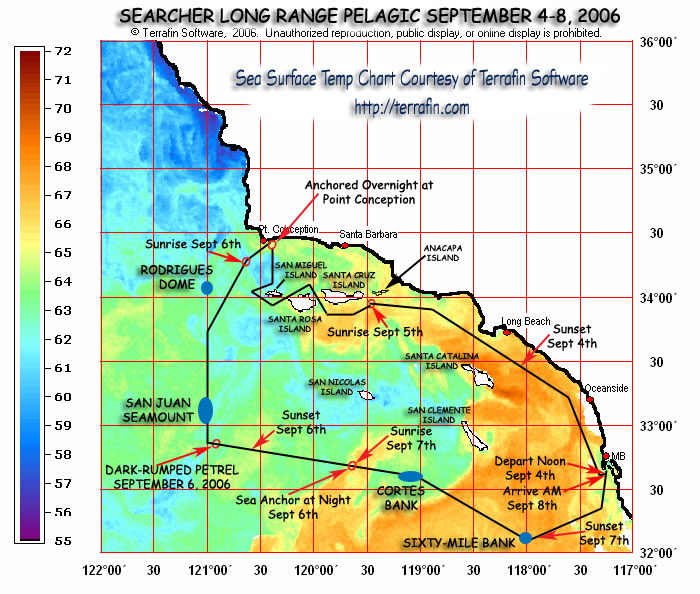
Trip Route (click for larger)


Report

Leaders: Todd McGrath, Steve Howell, Don Desjardin

Sept 4th

After stowing our gear and checking out our bunks, it was out on deck to start birding. The harbor in San Diego is an excellent place to bird, and our efforts were rewarded with good looks at some of the coastal species. A single Caspian Tern was noted along with many Elegants. A stop at the bait barge revealed hundreds of Brandt’s and a few Double-crested Cormorants. A few herons and egrets were also present along with high numbers of Western and Heerman’s Gulls.

Once we rounded Pt Loma and proceeded offshore, we were rewarded with excellent looks at Black-vented Shearwaters. This nearshore species normally does not arrive in numbers until October, but this year they arrived in July, our 1,500 plus was the most recorded on a fall Searcher trip. A Sabine’s Gull was also present very close to shore along with large numbers of Common and Elegant Terns. A single Least Tern was at the end of the window for this species.

Soon we began to record some storm-petrels, and mixed in with the expected Black Storm-petrels we found some Leach’s and at least 3 Ashy. Although Leach’s breed on the Coranado islands near San Diego, they are seldom seen close to shore. Ashy breed on the Channel Islands, but are rare near San Diego. Both were firsts in San Diego county for some of the leaders.

Further offshore a few Pink-footed Shearwaters were sighted, but our biggest surprise of the day was an adult Red-billed Tropicbird spotted just 9 miles off San Diego. Tropicbirds are occasionally recorded this close to the coast, but it was the first San Diego sighting for any Searcher birding trip (although every trip has recorded this species somewhere else along the route). Another Tropicbird 15 miles off the coast was  another highlight.

The weather forecast was for a bit of wind and chop, so we stayed close to shore as we headed north to the northern Channel Islands. After a fine Dinner we all headed off to our bunks to catch some sleep.

Sept 5th

This day is usually spent around the Northern Channel Islands, and is often the birdiest day of the trip. The cold water around the channel islands is rich in marine life, and both whales and birds are usually present in numbers. We encountered thousands of Pink-footed Shearwaters south of Santa Cruz Island, with hundreds of Sooty Shearwaters. We also found our first South Polar Skuas as well as Pomarine, Parasitic and Long-tailed Jaegers (The “Skua Slam”). This day was also our best day for alcids with Common Murre, Pigeon Guillemot, and Cassin’s and Rhinoceros Auklets all being recorded. We would also record one of our only two Northern Fulmars for the trip.  The blustery weather continued and we decided the cross the Santa Barbara channel and anchor near Pt Conception, where we could enjoy a comfortable dinner and get some sleep free from the wind and waves. On our passage across, we encountered numbers of Black-vented Shearwaters again.

September 6th

We pulled up anchor at 3:30 Am and headed southwest for the deep waters off the continental shelf. These deep waters are often rather unproductive, and we recorded only a few Sooty and Pink-footed shearwaters, but this was our best day for Buller’s Shearwaters. This species is often more common in the deeper waters, and this fall was no exception. Our first Black-footed Albatrosses put in appearance, and several Least Storm-petrels were seen distantly. Leach’s Storm-petrels are often abundant in these deep, warm waters, and we saw over 200 today.

By afternoon,we had crossed the San Juan Seamount, and were headed south east, over a deep 2000+ fathom shelf break. We had to see any of the Cook’s Petrels we were hoping for (there were numbers here last year). Todd McGrath spotted a distant bird arcing up on the horizon that didn’t look quite right, and he asked the captain to stop the boat, as the bird was headed towards us. The high arcing flight looked good for a Pteradroma petrel, but it seemed to big and dark for a Cook’s. The participants were all instructed to get on the bird as it approached, but Todd still wasn’t sure what it was. As it arced up and showed an all dark back, he thought it might be a Pink-footed shearwater. The next arc the bird showed it’s ventral surface, and the call of “Dark-rumped Petrel” was made. A few photos were snapped as the bird zipped up the port side. There are about 20 records for Dark-rumped Petrel in CA, but only three of these are from Southern California. A quick check of our position indicated we were in Ventura County (about 75 nmi sw of San Nicolas I.). We had just added a species to the Ventura County checklist, and many on the boat had added a life bird.

September 6th

We started the morning in deep water west of the Cortez Bank. Our first surprise of the morning was a Lesser Nighthawk making repeated passes around the boat at dawn. This was the first time I had seen this species offshore, but there are other pelagic records for this species. Next we crossed the bank, finding few birds with the exception of Leach’s storm-petrels and a few Black-footed Albatrosses. This final day is often hit or miss, and this year it was mostly miss until we arrived at the Sixty-mile Bank in the late afternoon. A large slick here attracted many Leach’s and Black-storm Petrels.  A diligent search through the flocks eventually led to good looks for all at Least Storm-petrels. These small petrels can often be difficult to pick out of a large flock, but the leaders worked diligently to ensure that everyone could pick them out. After a fine dinner, we all headed off to sleep, and pack for our early morning arrival back in San Diego.

Picture Gallery

4-Sep 5-Sep 6-Sep 7-Sep Total
Birds
Northern Shoveler 0 6 0 0 6
Black-footed Albatross 0 0 7 6 13
Northern Fulmar 0 1 1 0 2
Dark-Rumped Petrel 0 0 1 0 1
Pink-footed Shearwater 20 2000 1 2 2023
Buller’s Shearwater 0 2 19 0 21
Sooty Shearwater 0 600 9 2 611
Black-vented Shearwater 1500 300 0 0 1800
Leach’s Storm-petrel 7 0 83 200 290
Ashy Storm-petrel 3 1 1 0 5
Black Storm-petrel 30 0 10 55 95
Least Storm-petrel 0 0 1 5 6
Red-billed Tropicbird 2 0 1 1 4
Brown Pelican 250 75 0 2 327
Double Crested Cormorant 9 5 0 0 14
Pelagic Cormorant 2 3 0 0 5
Brandt’s Cormorant 500 20 0 0 520
Great-Blue Heron 6 0 2 0 8
Great Egret 6 0 0 0 6
Snowy Egret 14 0 0 0 14
Black-crowned Night-Heron 2 0 0 0 2
Red-necked Phalarope 200 9 0 7 216
Red Phalarope 6 3 7 41 57
South Polar Skua 0 5 0 0 5
Pomarine Jaeger 1 14 5 1 21
Parasitic Jaeger 2 2 0 1 5
Long-tailed Jaeger 0 1 4 1 6
Sabine’s Gull 4 1 1 0 6
California Gull 105 2 0 0 107
Heerman’s Gull 192 19 0 0 211
Western Gull 475 382 0 25 882
Least tern 1 0 0 0 1
Caspian Tern 1 0 0 0 1
Common Tern 500 0 0 0 500
Arctic Tern 0 0 7 6 13
Royal Tern 10 2 0 0 12
Elegant Tern 200 50 0 0 250
Common Murre 0 1 0 0 1
Pigeon Guillemot 0 3 0 0 3
Murrelet sp. 0 0 2 1 3
Cassin’s Auklet 0 5 0 9 14
Rhinocerous Auklet 0 4 0 0 4
Mourning Dove 0 1 0 0 1
Lesser Nighthawk 0 0 0 1 1
Western Tanager 0 0 0 1 1
Brown-headed Cowbird 0 0 2 1 3
Marine Mammals
Sea Otter 0 52 0 0 52
Guadalupe Fur Seal 0 0 4 0 4
Northern Fur Seal 0
California Sea Lion 152 42 0 6 200
Harbor Seal 2 0 0 0 2
Blue Whale 1 3 0 0 4
Fin Whale 4 7 0 0 11
Sei Whale 0 0 0 1 1
Short-beaked Common Dolphin 200 70 0 270
Long-beaked Common Dolphin 50 0 0 0 50
Common Dolphin Sp 0 200 0 0 200
2020-07-15T16:35:31-07:00September 8th, 2006|Trip Reports|

Pelagic Birding Tour Trip Report Apr 26-30, 2006

DATE: April 26-30, 2006

TRIP: Offshore Birding Trip

Picture Gallery

26-Apr 27-Apr 28-Apr 29-Apr
Red-throated Loon 2 5
Pacific Loon 5 500
Common Loon 90 16
Laysan Albatross 4
Black-footed Albatross 18 9
Northern Fulmar 3 18 17 12
Pink-footed Shearwater 48 36 500 12
Flesh-footed Shearwater 1 2
Sooty Shearwater 45 630 1098 65
Fork-tailed Storm-Petrel 2 5 1
Leach’s Storm-Petrel 35 58
Ashy Storm-Petrel 11
Black Storm-Petrel 35 325
Red-billed Tropicbird 2
Brown Pelican x x x
Brandt’s Cormorant 5 807 2
Double-crested Cormorant 1
Pelagic Cormorant 14 2
Brant 4
Surf Scoter 3 1
Semipalmated Plover 1
Black Oystercatcher 1
Long-billed Curlew 1
Black Turnstone 3
Red-necked Phalarope 500 360 66
Red Phalarope 100 156
Pomarine Jaeger 4 12 4
Parasitic Jaeger 3 4 1 2
Long-tailed Jaeger 2
jaeger sp. 4
Bonaparte’s Gull 100
Heermann’s Gull 2
California Gull x x x
Western Gull x x x x
Sabine’s Gull 1 5 2
Royal Tern 2 3
Elegant Tern 16
Arctic Tern 1
Forster’s Tern 2
Least Tern 4
Black Tern 1
Common Murre 7
Pigeon Guillemot 35
Xantus’s Murrelet 9 6 5 14
Cassin’s Auklet 12 34 113 11
Rhinoceros Auklet 6 16 5
Cliff Swallow 1
Barn Swallow 1
American Pipit 1
Yellow-rumped Warbler 4 3
Townsend’s Warbler 1
Golden-crowned Sparrow 1
Brewer’s Blackbird 2
Brown-headed Cowbird 2 2
MARINE MAMMALS
Humpback Whale 13 6
Blue Whale 2 1
beaked whale sp. 1
Bottlenosed Dolphin 20
Pacific White-sided Dolphin 50 3
Risso’s Dolphin 25
Dall’s Porpoise 5 66
Guadalupe Fur Seal 3
Northern Fur Seal 2 2
California Sea Lion x x x x
fur seal sp. 1
Northern Elephant Seal 100 1
Harbor Seal 1
OTHER MARINE LIFE
Mola Mola (Ocean Sunfish) 1
Blue Shark 1
2020-07-15T16:35:31-07:00April 30th, 2006|Trip Reports|

Pelagic Birding Tour Trip Report Sep 5-9, 2005

DATE: September 5-9, 2005

TRIP: Offshore Birding Trip

Daily Journal

Species List

Daily Journal

By Todd McGrath, Walter Wehtje and Don DesJardin

Day One: San Diego and points north.

After an orientation of the boat and an introduction of the leaders (Don DesJardin, Mary Gustafson, Todd McGrath and Walter Wehtje), we began our multi-day exploration of the waters off southern California. While still in San Diego Bay, ELEGANT TERNS a few ROYAL TERNS, and BROWN PELICANS were seen in good numbers. A stop at the bait barge yielded excellent looks at BRANDT’S CRMORANTS, SNOWY and GREAT EGRETS, as well as good numbers of HEERMAN’S and WESTERN GULLS. We also saw hundreds of CALIFORNIA SEA LIONS sprawled out on the barges, napping after taking advantage of the ample food source discarded sardines and anchovies provide.

As we continued out of the bay, bird numbers picked up, with large groups of migrating COMMON TERNS feeding over massive numbers of anchovies. The baitfish were close to shore and also attracted the attention of BROWN PELICANS and BRANDT’S CORMORANTS. After turning northwards we spotted three BLACK-VENTED SHEARWATERS sitting on the water. We made a short stop so everyone could get a good look at this near-shore species. Black-vented Shearwaters are just beginning to arrive in California in early Sept., so the eight recorded this first day were good finds. Our first of many RED-NECKED PHALAROPES were also seen flying by in small groups. Farther along the coast we saw more COMMON TERNS as well as our first PINK-FOOTED and SOOTY SHEARWATERS. Jaegers were well represented with a POMARINE and 2 PARASTIC JAEGERS, with a well-seen SOUTH POLAR SKUA added for good measure. Good numbers of BLACK and a single LEAST STORM-PETREL were spotted, but as is often the case, the LEAST STORM-PETREL was not seen well by all.

Marine Mammals were also well represented with sightings of NORTHERN ELEPHANT SEAL, BOTTLENOSE DOLPHIN, both SHORT-BEAKED and LONG-BEAKED COMMON DOLPHINS, as well as a pair of MINKE WHALES.

After a fine dinner, most of us headed off to bed early in anticipation of a busy second day. During the night the weather (which was beautiful our first day) began to worsen, with increasing wind and swell.

Day Two:

South of Santa Rosa Island, San Miguel Island, Cojo Anchorage

At dawn we were about halfway between Santa Rosa and San Nicolas Islands. Our plan was to work westward in order to explore several promising temperature breaks, including the area where North America’s first Hornby’s Storm-petrel had been observed in early August, and then head north to Pt Conception. This was our most challenging day weather-wise, as we needed to proceed into 15 mph wind and 4-6’ swells. The area we covered is often very productive, but after determining that the storm-petrel hadn’t stuck around, we turned north towards San Miguel Island at 0915. Despite the challenging viewing conditions we saw our first BLACK-FOOTED ALBATROSSES, SABINE’S GULLS, and LONG-TAILED JAEGERS, along with 6 SOUTH POLAR SKUAS. Our first BULLER’S SHEARWATERS were also a welcome sight, as this species is irregular in Southern California in early September.

At 1200 we reached San Miguel Island, where we anchored at Crook Point and ate lunch in sheltered waters. After giving everyone the opportunity to regain their sea legs, we lifted anchor at 1330 and headed west to see what we could find beyond San Miguel Island. As before, the birds were present, but hard to keep in view. We had a much easier time with a pair of HUMPBACK WHALES. One of them kept slapping its wing-like pectoral fins and tail flukes at the surface, making them visible from almost a mile away. After seeing our fill, we continued north, arriving at Cojo Anchorage near Pt. Conception in time for dinner. After enjoying the beautiful sunset and spectacular starry skies we went down to our bunks, and several hours of relaxing sleep.

Day 3:

South to the San Juan Seamount

At 0400 the “Searcher” left Cojo Anchorage. With the strong NW winds and 6-8’ swells, we decided to keep our course at 195 o to keep everyone comfortable. The water temperature was 57 o F, and we didn’t expect much until the waters warmed near the San Juan Seamount, 85 miles to our south. Around 0715, we hit a very rough patch of water that demarcated a shift in the water temperatures. The water rose up to 62.5 o F within a few miles, and just before 8AM Todd McGrath spotted the first COOK’S PETREL of the trip. We were less than 20 miles southwest of San Miguel Island in an area where we did not expect this species. A few people were still below deck so, while many got an excellent look at this bird, some missed it. Todd was particularly pleased to have found it, as it was his 800 th ABA area bird. Paul Sykes was less pleased, as he’d just been reassured that we were unlikely to see Cook’s Petrels for several more hours, and had gone down to his cabin for a spell.

Luckily, at lunchtime a second bird circled the boat and provided almost everyone with great looks. We would see another 4 COOK’S PETRELS before dark, several of which put on a show for us. By mid-afternoon we reached the San Juan Seamount, and the birding became excellent. Our first of 5 adult RED-BILLED TROPICBIRDS were seen here. Usually Red-billed Tropicbirds are closer inshore, and this was the first time we’ve found them beyond the continental shelf. The most unexpected sighting occurred while everyone was watching a Cook’s Petrel fly southwards parallel with the boat. Todd McGrath got on a dark pterodroma flying northwards, and recognized it as a MURPHY’S PETREL. Murphy’s Petrel is regular in spring, but there are very few records from other seasons. As we left the San Juan Seamount, our only NORTHERN FULMAR of the trip followed our wake for some time. This species is irruptive and 2005 has been a down year, with very few reported. We also saw small numbers of CASSIN’S AUKLETS as well as more BLACK-FOOTED ALBATROSSES. In this area our trolling effort gave result with two SKIPJACK tuna pulled aboard. We motored along until 2330, when the crew set the sea anchor (a large underwater parachute). The weather was still less than ideal, but most of us managed to sleep in spite of the rocking.

Day 4:

32° N, 120° 30’ W to Sixty-mile Bank

The birding day began at 0001. The boat’s lights brought in a variety of birds, and by 0030 hundreds of RED PHALAROPES had been by the boat, as well as a couple of COOK’S PETRELS. A few hardy individuals stayed out on deck until 0230. In that time they recorded hundreds, perhaps thousands of RED PHALAROPES, as well as dozens of RED-NECKED PAHALAROPES, 2 SABINE’S GULLS, 2 ARCTIC TERNS, and a total of 4 COOK’S PETRELS. One of these birds flew into the lights, circled the boat and landed on the water no more than 3 feet from Todd McGrath and two other night-owls. A circling WHIMBREL called repeatedly dropped into the lights, a strange sight more than 130 miles from shore.

At 0500, we began pouring out our chum slick in earnest, with high hopes. At 0620 an all-dark bird with a pale bill came into the boat. It was initially called a FLESH-FOOTED SHEARWATER by Mary Gustafson. Flesh-footed Shearwater is quite rare beyond the continental shelf and that far south, so Todd McGrath wanted to be sure to eliminate Parkinson’s Petrel (a bird reported several times for North America but not yet documented). The best separating feature is leg color, with Parkinson’s Petrel showing black legs as opposed to the pinkish legs that give Flesh-footed it’s name. In the low early morning light, leg color could not be discerned for certain, but Todd and Mary decided that other marks such as the overall brown coloration without a contrast with the head, size and shape of the bill, and overall structure and size supported Mary’s original ID as a Flesh-footed Shearwater. Walter Wehtje was troubled by what looked like the feet of the bird extending beyond the tail, reminiscent of a Black-footed Albatross, but decided that this was one of those birds one has to leave unidentified. As it got lighter, we had good looks at several RED-BILLED TROPICBIRDS, with 7 seen that day, bringing our total for the trip to an even dozen.

As we proceeded eastwards, we encountered the slowest birding of the trip. Normally this area is calm, allowing us to find birds on the surface some distance out. Unfortunately, an unseasonable pressure differential kept the winds at 15+ mph for most of the day, and we saw relatively few birds until we reached Sixty-mile Bank. Occasional LEACH’S STORM-PETRELS and a couple of COOK’S PETRELS in Los Angeles County waters, and two fly-by CRAVERI’S MURRELETS were the highlights until the Sixty-mile Bank. At the bank we anchored for dinner and put out a large tuna oil slick. Over the next hour and a half we were treated to excellent views of dozens of LEACH’S and BLACK STORM-PETRELS. Mixed in among them were a few LEAST STORM-PETRELS, and through the efforts of Todd and Mary, EVERYONE got good looks at this smallest of the World’s Storm-petrels. Another small storm-petrel mixed in with the Leach’s turned out to be a summer breeding Guadalupe LEACH’S STORM-PETREL. There has been some discussion over the years on the taxonomy of Leach’s subspecies, and at least some have proposed elevating the two Guadalupe Island breeders to full species status. Under normal circumstances, identification of Guadalupe birds would be difficult, but direct comparison with other Leach’s showed the smaller size and coloration differences well. After our final dinner, we stayed at Sixty-mile Bank until 2300. Captain Kevin Ward then pulled up the anchor and set course for San Diego. We arrived in harbor early next morning, and after docking and wishing each other well, set off to our respective destinations.

While the weather was less than cooperative for much of our journey, we saw an excellent variety of birds, most very well. We ate well, and enjoyed the company of a great group of birders. We hope to see all of you in the field or out on the ocean again.

Picture Gallery

5-Sep 6-Sep 7-Sep 8-Sep Total
Pelagic Birds
Black-footed Albatross 2 7 3 12
Northern Fulmar 1 1
Murphy’s Petrel 1 1
Cook’s Petrel 6 7 13
Pink-footed Shearwater 78 175 67 2 322
Flesh-footed Shearwater 1 1
Buller’s Shearwater 8 2 1 11
Sooty Shearwater 21 125 43 3 192
Black-vented Shearwater 8 8
Leach’s Storm-petrel 80 106 186
Ashy Storm-petrel 1 1
Black Storm-petrel 35 15 50
Least Storm-petrel 1 3 4
Red-billed Tropicbird 5 7 12
Red-necked Phalarope 45 250 15 40 350
Red Phalarope 1 500+ 1
South Polar Skua 1 6 1 8
Pomarine Jaeger 1 5 6
Parasitic Jaeger 2 2 4
Long-tailed Jaeger 1 2 2 5
Sabine’s Gull 3 2 5
Arctic Tern 1 3 4
Common Tern 800 800
Craveri’s Murrelet 2 2
Cassin’s Auklet 3 13 10 26
0
Other Birds 0
Brown Pelican 175 35 210
Brandt’s Cormorant 400 170 570
Great Egret 3 3
Snowy Egret 30 30
Great-Blue Heron 2 2
Black-crowned Night-Heron 1 1
Peregrine Falcon 1 1
Whimbrel 1 1
Heerman’s Gull many X X X many
California Gull 2 2
Western Gull many X X X many
Caspian Tern 3 3
Royal Tern 3 3 6
Elegant Tern 200 200
Marine Mammals
Guadalupe Fur Seal 1 1
Northern Fur Seal 1 1
California Sea Lion 150 7 3 5 165
Harbor Seal 3 3
Northern Elephant Seal 1 1
Humpback Whale 2 2
Minke Whale 2 2
Blue Whale 3 3 6
Common Bottlenosed Dolphin 10 10
Short-beaked Common Dolphin 500 50 550
Long-beaked Common Dolphin 6 6
Pacific White-sided Dolphin 15 15 30
Risso’s Dolphin 5 5
Other Marine Life
Mola Mola 5 3 1 9
Skipjack 2 2
Blue Shark 1 1
By-the wind sailors many many
2020-07-15T16:35:31-07:00September 9th, 2005|Trip Reports|

Pelagic Birding Tour Trip Report Apr 13-17, 2005

DATE: April 13- 17, 2005

TRIP: Offshore Birding Trip

Daily Journal

Picture Gallery

Species List

Daily Journal

13 April: San Diego towards Los Angeles.

We departed Fisherman’s Landing at noon on Wednesday the 13th, and headed to the bait docks so many of our out-of-state and Canadian birders could fill up on local species such as Brandt’s Cormorants, Western gulls, Heermann’s Gulls, and the ubiquitous California Sea Lions. From here we headed out of San Diego Harbor, out past Point Loma, and once we were three miles offshore, given access to the upper deck and bridge area, from where our view of our surroundings improved dramatically. The ocean temperature was near 60° F (15° C.), During the day the weather was comfortable, with slight NW winds, temperatures in the low 60’s and a 3-4’ swell out of the NW. Nothing out of the ordinary, but enough to make at least one of your leaders queasy. Once out on the ocean, we headed NNW paralleling the coast at a distance of 10-20 miles for the remainder of the day. Apart from the bird species, we also had good looks at fin whales, a species we’ve seen in this area each of the three years that we’ve now done these trips.

14 April: Santa Barbara Channel, Anacapa Island, Santa Cruz Basin, Santa Rosa Passage, Cojo Anchorage.

At 0500 we were south of Santa Barbara, but with a bit of a swell out of the W, and the weather forecast predicting increasing winds throughout the day, we decided to spend the day more comfortably and headed SE towards Anacapa Island. We reached the island a little after breakfast, and circumnavigated this smallest of the Channel Islands while keeping an eye out for Pigeon Guillemots and Pelagic Cormorants. Both species were seen to everyone’s satisfaction, while a few handfuls of popcorn seemed to attract every Western gull on the island. We passed Arch rock on the east end of the island and then headed SW towards the Santa Cruz Basin, a deepwater region that lies to the south of Santa Cruz and Santa Rosa Islands. An additional benefit of this route was that it allowed us to bird comfortably throughout the day while in the lee of the northern Channel Islands. by 2 PM we were near the Santa Rosa Passage, and the number of Pigeon Guillemots and Pacific Loons increased, a sure sign that the water was getting shallower. We finally entered the western edge of the Santa Barbara Channel, and headed NW towards Cojo Anchorage, just east of Point Conception. By now the wind had worked up a considerable swell, but it amounted to a few hours of pitching before we entered the lee of the mainland and pulled into Cojo Anchorage. Here the wind was blowing over 20 mph (35 km/h), but with land within ½ mile we rode at anchor comfortably. As a bonus we picked up three Gray Whales, a Turkey Vulture, several Black Brant, and a Barn Swallow. An unusual touch was seeing trains pass by along the coast and hearing their whistles as the evening closed in. After another fine supper, everyone got a good night’s sleep, at least until 0400.

15 April Cojo Anchorage, Patton Escarpment, San Juan Seamount

Kevin Ward pulled the anchor at 0400, and headed as close to the wind as he dared once we left the lee of the mainland. We were trying for a SW course, but the swells were a bit too large, so we settled for a heading of 190°, which would take us towards San Juan Seamount by the afternoon. At first light we were NW of San Miguel Island, the water temperature was close to 50° F (10° C), and the wind was gusting above 30 mph, or near-gale conditions. Luckily, we had the swells on our stern quarter, and the “Searcher” rode them well. Large numbers of birds were present, including dozens of Bonaparte’s Gulls, several Common Murres, and small flocks of Cassin’s Auklets. Most passengers were still in their bunks at 0630 when the first Murphy’s Petrel crossed in front of the bridge at about 30’. Todd McGrath immediately got on the intercom, called out the sighting, but to no avail; the bird was long gone, and the intercom was out of commission due to a loose wire. The wire was tightened, the bird re-announced, and wonder of wonders, suddenly 20 people were out on deck waiting for the next sighting. It came rather quickly, once again passing in front of the boat, but at 0745 a third Murphy’s Petrel came up the wake and hung above the stern for close to a minute before veering off. It was called out by one of the leaders, seen well by everyone, and then strung into a Northern Fulmar by the leader who didn’t see sufficient white wing flash to feel comfortable with the identification. Never mind the smaller size, pale chin, dark bill, jerky flight style, bent wings and leaner jizz. Upon due reflection everyone agreed that the leader had suffered an acute attack of single field-characteristicitis, and the Murphy’s Petrel was added to everyone’s life list. By now the water temperature had risen to 56° F (13° C). We continued on this same heading for much of the day, seeing a nice variety of species, including Laysan and Black-footed Albatross, Leach’s Storm-petrel, and good numbers of Pomarine Jaegers that dove for popcorn in the wake. While the weather was impressive, with swells approaching 14’ in height, sailing downwind made for one of those memorable days at sea when one could enjoy the immensity and power of the ocean without suffering the usual side effects. As the day progressed and we got farther south the wind began to lessen, the swells decrease, and after passing over the San Juan Seamount, we headed Southeast over deeper water and reaching the Patton Escarpment by evening.

16 April: Patton Escarpment, Butterfly Bank, 60 Mile Bank

During the night we motored slowly SSE along the Patton Escarpment, and at 0500 were approximately 80 miles (130 km) south of San Nicolas Island. The water temperature was 60.6° F (15.9° C). At this point we turned the “Searcher” around, and began heading upwind, laying out a menhaden oil slick, and boiling cabbage on the galley stove. The idea with the cabbage was that it gives off dimethyl sulfide when heated, which is the same compound released by zooplankton when they feed on phytoplankton. Procellarids are sensitive to this smell, and will fly towards it. We moved upwind for 2 hours before retracing our steps. The slick and cabbage fumes did their magic, and we were rewarded with a Murphy’s Petrel, a Laysan Albatross, a Black-footed Albatross, and several Leach’s Storm-petrels. Not too bad a start to the bird list before 8 AM. The Murphy’s Petrel left us after a while, but the two albatrosses lingered. We began heading east, looking for warmer waters and Red-billed Tropicbirds, but there were few birds visible for much of the time, with only an occasional albatross coming up the stern to investigate us. As we traveled east the water temperature dropped by a dgree or two, and we began to see surprisingly large numbers of Red Phalaropes and Cassin’s Auklets. Leach’s Storm-petrels were also seen on a regular basis, but we were still looking for tropicbirds. Finally by mid –afternoon we spotted first one and then a second Red-billed Tropicbird, both were first spotted on the water, and then flew off as we approached them. Sighting a group of three sperm whales was also a treat. As the afternoon wore on we stopped at Sixtymile Bank, let out a large slick, and had a good gathering of Black Storm-petrels, a few fulmars, and a Black-footed Albatross that gave wonderful views as it devoured some chum near the “Searcher”. Once everyone had seen their fill of these birds, we decided to leave the USA, crossed into Mexican waters, and quickly tallied eight species, including excellent looks at several pairs of Xantus’ Murrelets. We continued to bird until dark, but finally had to give up as it became too dark to identify the birds we saw. We decided to call is a trip. Dinner beckoned, and after one last wrap-up, we all got a good night’s sleep before docking at the berth in San Diego at 7 Am the following morning.

Picture Gallery

Species 4/13 4/14 4/15 4/16 Totals
Pacific Loon 4 40 44
Red-throated Loon 1 1
Common Loon 1 1 2
Eared Grebe 2 1 3
Laysan Albatross 3 3 6
Black-footed albatross 3 3 6
Northern Fulmar 1 3 6 10
Murphy’s Petrel 9 1 10
Sooty Shearwater 25 375 95 1 496
Pink-footed Shearwater 20 40 30 90
Flesh-footed Shearwater 1 1
Black-vented Shearwater 15 50 65
Leach’s Storm-petrel 15 75 90
Black Storm-petrel 2 24 26
Red-billed Tropicbird 2 2
Brown Pelican 37 100s 37
Double-crested Cormorant 21 15 36
Brandt’s Cormorant 150 1,000 1,150
Pelagic Cormorant 50 50
Black Brant 25 25
Surf Scoter 4 30 34
Black Oystercatcher 2 2 4
Turkey Vulture 1 1
Red Phalarope 2 15 200 180 397
Red-necked Phalarope 55 75 300 430
Pomarine Jaeger 2 7 20 1 30
Parasitic Jaeger 2 2
Heermann’s Gull 11 3 14
Bonaparte’s Gull 31 200 65 296
California Gull 23 50 73
Western Gull 155 1,000 51 11 1,217
Glaucous-winged Gull 1 1
Herring Gull 2 2
Sabine’s Gull 50 7 57
Elegant Tern 31 4 35
Royal Tern 2 2 4
Forster’s Tern 1 8 9
Pigeon Guillemot 60 60
Cassin’s Auklet 4 20 100 90 214
Common Murre 5 5
Xantus’s Murrelet 2 2 2 3 9
Rhinoceros Auklet 2 35 20 1 58
Rufous Hummingbird 1 1
Barn Swallow 1 1
Whale sp. 1 1
Gray Whale 3 3
Humpbacked Whale 4 4
Fin whale 3 1 4
Sperm Whale 3 3
Dall’s Porpoise 2 2
Risso’s Dolphin 8 8
Long-beaked Common dolphin 55 55
Short-beakd Common Dolphin 25 25
Pacific White-sided Dolphin 15 8 23
Northern Right-whale Dolphin 10 10
California Sea Lion 100 15 3 118
Guadalupe Fur Seal 2 2
2020-07-15T16:35:32-07:00April 16th, 2005|Trip Reports|

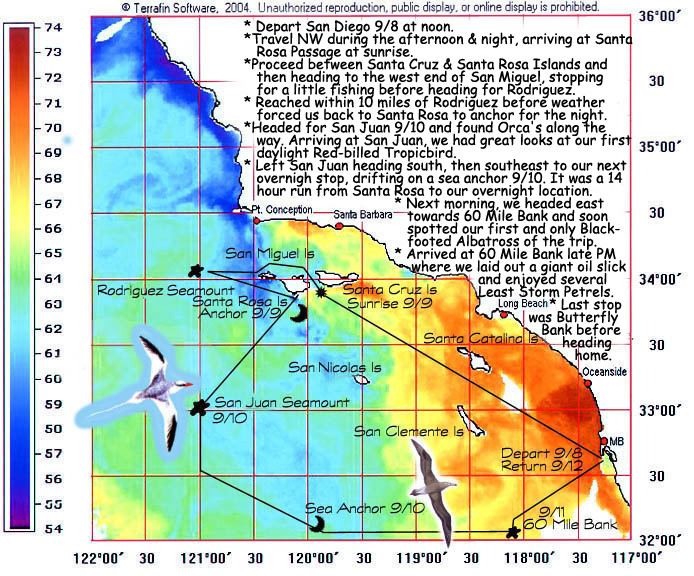
Pelagic Birding Tour Trip Report Sept. 8 – 12, 2004

Sightings List for Sept. 8-12, 2004 Offshore Birding Trip.

Species 09/08 09/09 09/10 09/11 Totals
Black-footed Albatross 1 1
Northern Fulmar 5 5
Pink-footed Shearwater 18 2408 131 31 2588
Flesh-footed Shearwater 1 1
Buller’s Shearwater 2 5 7
Sooty Shearwater 22 9 3 34
Black-vented Shearwater 4 7 11
Ashy Storm-petrel 6 6
Black Storm-petrel 61 46 29 34 170
Least Storm-petrel 10 9 19
Red-billed Tropicbird 1 1 2
Marbled Godwit 1 1
Red-necked Phalarope 25 476 10 511
Red Phalarope 2 14 20 426 462
South Polar Skua 6 6
Parasitic Jaeger 3 10 13
Pomarine Jaeger 4 12 2 2 29
Long-tailed Jaeger 2 4 2 1 9
Jaeger sp. 8 20 1 29
California Gull 2 1 3
Heermann’s Gull 18 6 34
Western Gull 20 540 64 7 631
Sabine’s Gull 42 4 1 47
Common Tern 3 3
Arctic Tern 3 5 14 30 52
sterna tern sp. 30 9 7 2 48
Xantus’ Murrelet 1 1
Craveri’s Murrelet 2 2
murrelet sp. 2 2
Cassin’s Auklet 4 1 5
Rhinoceros Auklet 2 2
Brown-headed Cowbird 1 1
Common Dolphin 800 600 25 500 1985
Risso’s Dolphin 25 70 95
Killer Whale (Orca) 7 7
Baird’s Beaked Whale 3 1 4
Blue Whale 6 7 3 16
Fin Whale 1 1
Sei Whale* 1 1
Humpback Whale 1 1
California Sea Lion 300 300
Harbor Seal 4 4
Elephant Seal 1 1

*Note: Although some whales can be difficult to identify
to exact species if observed

only briefly, what was seen on this whale–the falcate
dorsal fin and overall

color– did not point to fin or blue, but to a probable
sei.

– Other interesting animals seen were Ocean Sunfish (Mola Mola), Swordfish,
and

several Skipjack Tuna (caught). Royal Tern, Elegant Tern, Brown Pelican,

Brandt’s, Pelagic, and Double-crested Cormorant were also seen, most very close

to shore.
2020-07-15T16:35:32-07:00September 12th, 2004|Trip Reports|

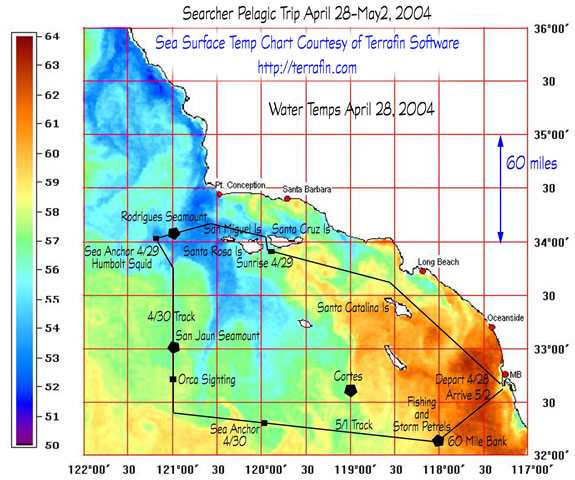
Pelagic Birding Tour Trip Report Apr 28 – May 2, 2004

Sightings List for April 28-May 2, 2004 Offshore Birding Trip.

Species Totals
Pacific Loon 48
Laysan Albatross 20
Black-footed Albatross 17
Northern Fulmar 135
Pink-footed Shearwater 81
Sooty Shearwater 120
Manx Shearwater 1
Black-vented Shearwater 39
Leach’s Storm-petrel 51
Ashy Storm-petrel 7
Black Storm-petrel 17
Red-billed Tropicbird 6
Brown Pelican Many
Brandt’s Cormorant Many
Double-crested Cormorant 3
Pelagic Cormorant 21
Surf Scoter 1
Whimbrel 23
Red-necked Phalarope 125
Red Phalarope 45
Pomarine Jeager 23
Bonaparte’s Gull 1
Heerman’s Gull 7
California Gull 19
Western Gull Many
Sabine’s Gull 33
Royal Tern 35
Elegant Tern 17
Common Tern 4
Arctic Tern 2
Least Tern 9
Pigeon Guillemot 8
Xantus’s Murrelet 20
Cassin Auklet 200+
Mourning Dove 1
Barn Swallow 1
Yellow Warbler 1
Wilson’s Warbler 1
Whales, Dolphins and other Marine Mammals
Humpback Whale 5
Fin Whale 3
Long-beaked Common Dolphin 15
Short-beaked Common Dolphin 100
Cuvier’s Beaked-whale 1
Pacific White-sided Dolphin 30
Risso’s Dolphin 8
Orcas 12
Dall’s Porpoise 20
California Seal Lion Many
Elephant Seal 2
Northern Fur Seal 2
Other Marine Life
Mola Mola (Ocean Sunfish)
Blue Shark
Mako Shark
Pacific Saurie
Scad mackerel
Ocean Whitefish
Vermillion Rockfish
Flying fish
Humbolt Squid
By-the-wind Sailors
2020-07-15T16:35:32-07:00May 4th, 2004|Trip Reports|

Go to Top